Folklore and Legends
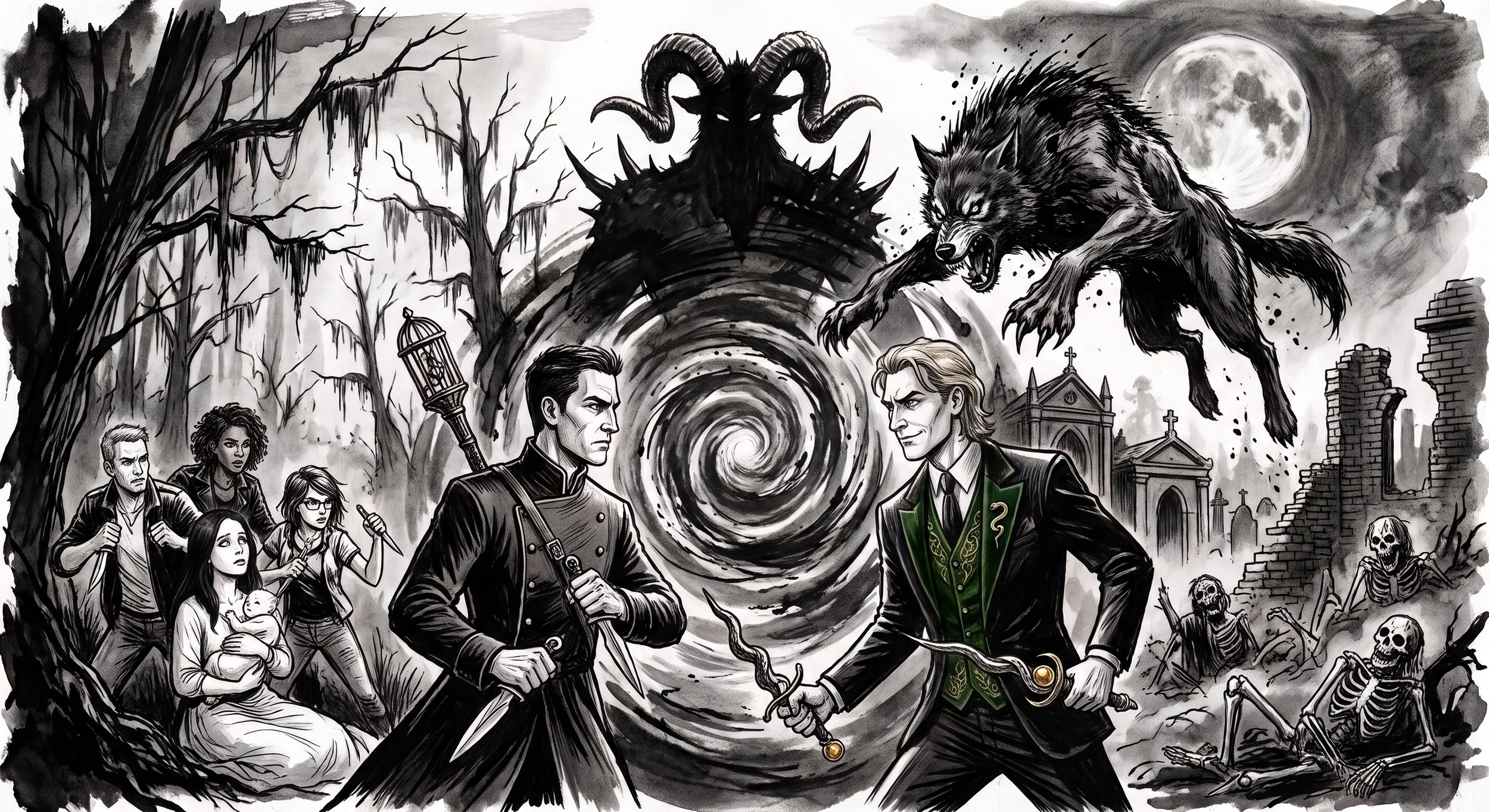
From every flower of creativity, there is an origin consisting of a seed, water, sunlight and soil. I remember sitting in the tower one day (No, I don’t live in a castle, I was employed by the Commonwealth as a Correction Officer in a maximum security prison) when a seed of an idea was planted in my ever-busy plant pot of a mind. I decided that I wanted to write a novel. Writing wasn’t new to me as I had already written song lyrics for about fifty musical numbers, magazine articles and instructional manuals. But the idea of writing an entire novel was new. That was an entirely different monster. What would I write about? Having been a lifelong fan of horror and science fiction films, the choice to focus on one of those genres had become immediately obvious. After much thought, I decided on doing a werewolf story, but in reverse. I came up with an introduction long before any actual story had formed and sent it out to several friends and relatives who I knew were avid readers. This is where the seed received some much-needed water.
A gentleman by the name of Steven Correira got back to me almost immediately saying that as he read my newly-penned intro, he felt as though he were watching a movie, that my writing was very cinematic. This not only prompted me to go through with the writing of the rest of the book but also gave me a methodology for doing so. I have no idea if other writers do this, but because of my affinity for classic Hollywood and my brother’s comment, I started playing each scene of the story in my mind like an old Universal horror movie. I was now the Director and Screenplay Author and even Casting Director. My mental movie of ‘Sapienthropy’ was filled with the likes of Hollywood legends such as Lon Chaney Jr., Claudette Colbert, Paul Muni and David Manners. Thanks, Steve, for the inspiration.
Once it was written, I naively enlisted the services of a publisher that I will say nothing about other than they did nothing to promote my freshman effort. I had put down my pen and focus on other things until a ray of sunlight shone down upon the dying plant of Authorship. Someone from the distant past had re-entered my life and prompted me to finish the follow-up novel. Eventually, I not only turned Walker’s story into a trilogy, but penned a fourth novel as well, which was based on a drawing I did in high school for a friend’s birthday present. Oh, and this beautiful and amazing person from my past miraculously agreed to be my wife
Finally, no book is ready to publish without an editor. That’s someone who goes through your manuscript, tweaks things, omits things, make suggestions for supplemental material, and sometimes makes you feel like a third grader trying to push through your first book report. Ultimately, the end result becomes a polished, professional piece of work ready for mass consumption (hopefully). Enter the talented and ultra-intelligent Amanda Palloven, who has also agreed to work with me on my subsequent novels.
Thanks to all of you for gently guiding me into making this new universe I’ve mentally concocted into a literary reality.
—’Sijo’ Art Lapham
Fall River Skeleton in The Armor
The Legend:
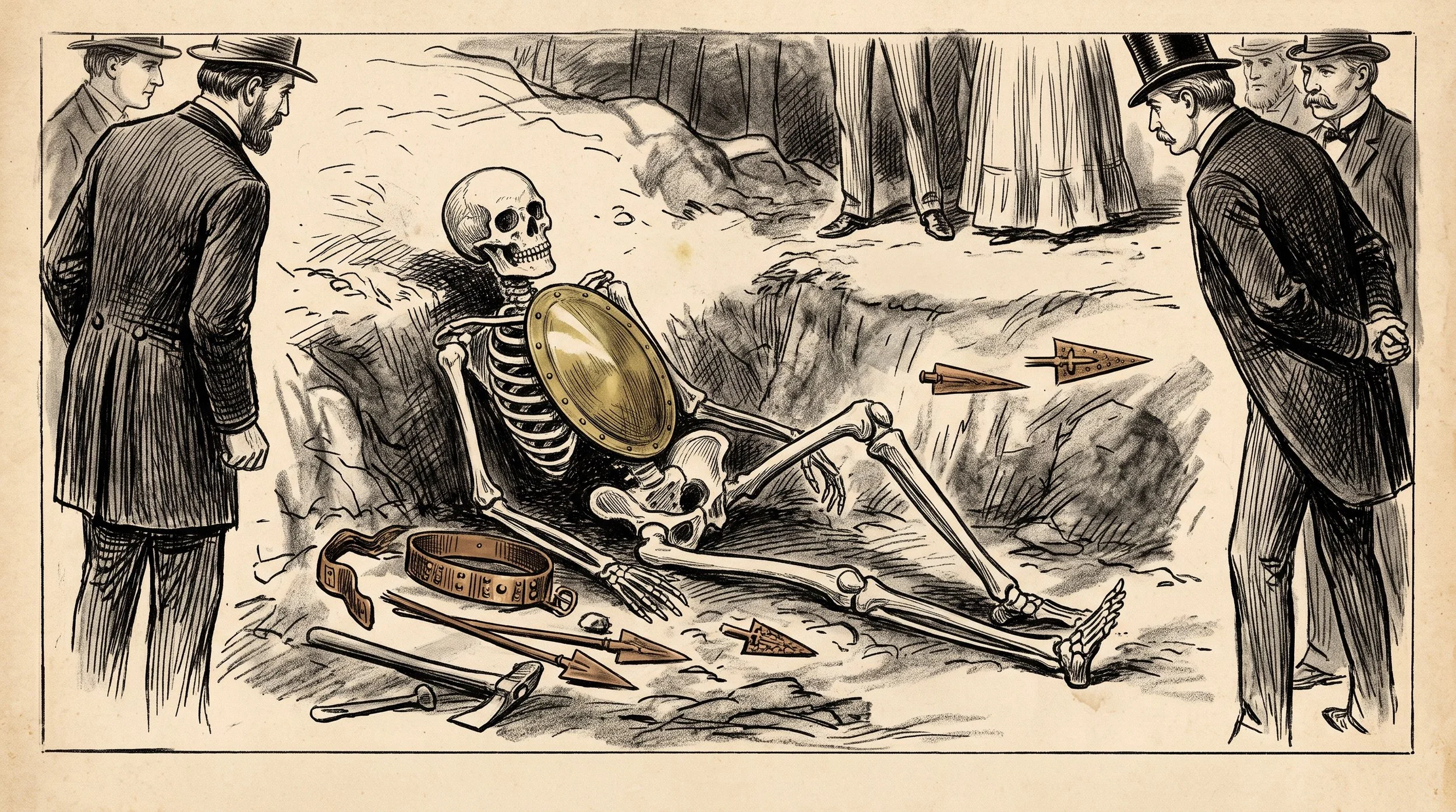
In 1832, a skeleton buried with a brass breastplate and copper arrows was unearthed in Fall River, Massachusetts. The mysterious discovery sparked popular speculation about early Viking exploration in North America and famously inspired Henry Wadsworth Longfellow's poem, "The Skeleton in Armor."
Book Tie-In:
In the novel, the historical 1832 Fall River "Skeleton in Armor" is reimagined as the remains of a Native American warrior whom the demonic antagonist, Seth, and a Vodun priest transformed into a supernaturally powerful zombie to fight the immortal protagonist, Walker. The skeleton's famous brass breastplate is revealed to have been forged from an exotic, ancient Phoenician metal capable of completely masking its wearer's presence from Walker's supernatural senses. During their 19th-century confrontation, a fire destroyed the building housing the skeleton, allowing Seth to secretly steal the mystical chest plate and mask his escape. In the present-day narrative, Seth resurfaces using the metal from this very armor to remain undetected by Walker, tying the real-world Massachusetts historical mystery directly into Seth's modern, apocalyptic plot to open a permanent portal to his demonic home world.
Marie Laveau
The Legend:
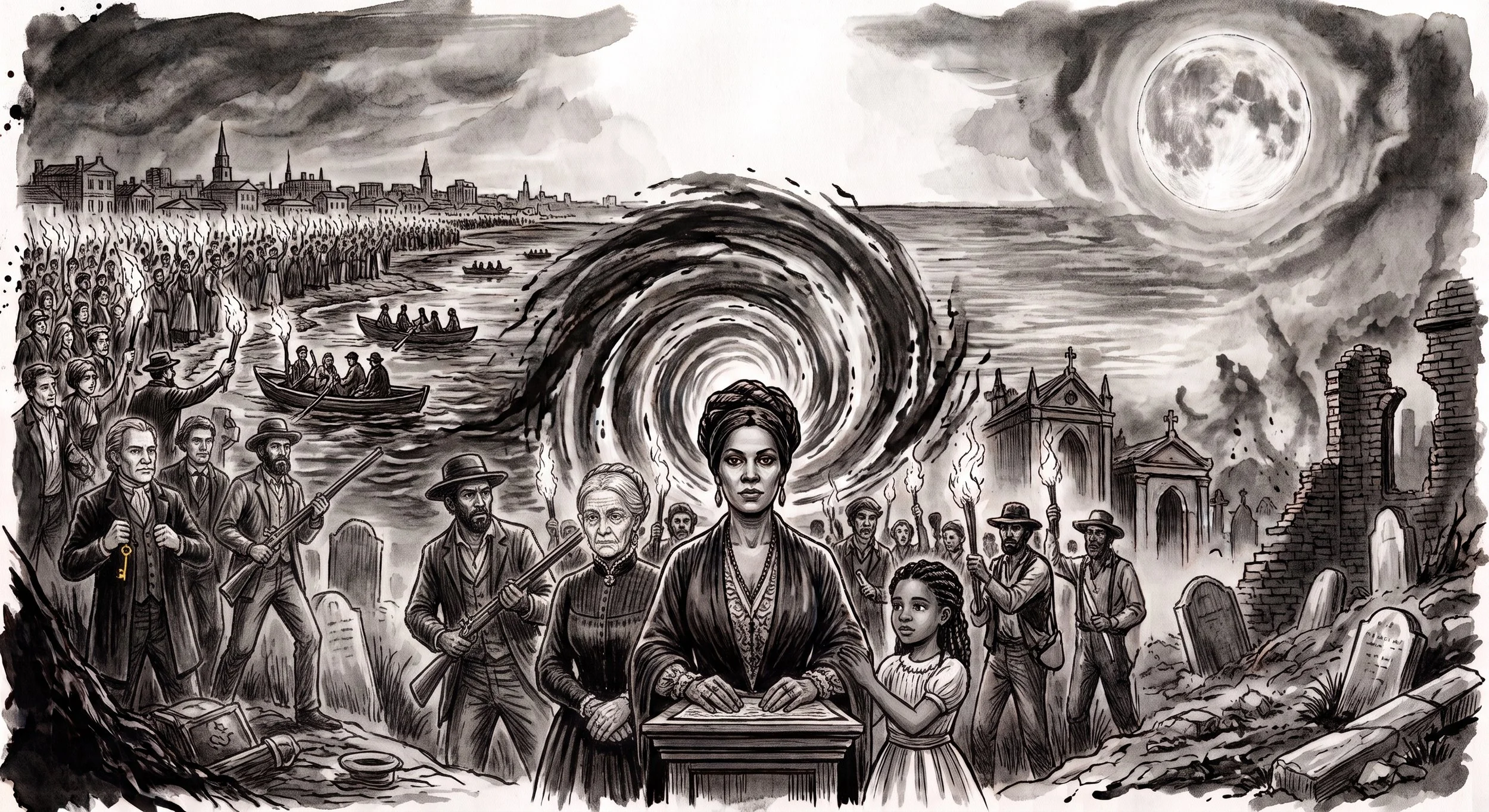
Marie Laveau (c. 1801–1881) is historically renowned as the Voodoo Queen of New Orleans, a powerful Louisiana Creole practitioner famous for her mastery of herbalism, healing, and occult rituals. She wielded immense social and political influence across all classes of 19th-century New Orleans society, seamlessly blending Catholic traditions with West African spiritual practices. Among her most famous activities were the massive, ecstatic ceremonies she led on St. John's Eve along the shores of Lake Pontchartrain and Bayou St. John, events that attracted thousands of followers and spectators.
Book Tie-In:
In the novel, the ‘Sijo’ Art Lapham weaves Laveau's historical legacy into the fictional supernatural mythology of the Caplata (female Vodun priestesses) to ground the story's lore in real-world New Orleans history.
The Lineage of the Caplata: When the demonic antagonist Seth asks the elderly priestess Vesper Diprey if she is a blood relative of Marie Laveau, Vesper clarifies that she is not. The novel establishes that Vesper's family line traces all the way back to ancient Aksum and Ghana, charged with guarding the dark secrets of creating zombies. When one of Vesper's ancestors died prematurely before she could pass the knowledge to her daughter, Marie Laveau stepped in to temporarily carry the mantle. Laveau's daughter eventually passed the responsibility back to Vesper's great-grandmother, restoring the original family line.
The 1874 Lake Pontchartrain Battle: The novel re-contextualizes Marie Laveau's famous St. John's Eve gatherings as a pivotal supernatural conflict. Seth specifically references a massive event on June 24, 1874, at Lake Pontchartrain, where over twelve thousand followers—led by the Laveaus and Vesper's great-grandmother—gathered with lit torches and silver-tipped knives to fight off a demonic threat.
The Climactic Setting: Because of the portal Walker opened during that historical 1874 battle, the fabric of reality at Lake Pontchartrain was permanently weakened. This historical tie-in directly sets the stage for the novel's climax, as Seth chooses the exact anniversary and location of that 19th-century confrontation to attempt to open his permanent gateway to hell.
The Huldra
The Legend:
In Scandinavian mythology, the Huldra (or hulder) is an alluring, seductive forest spirit associated with the wildness of nature. She appears as an incredibly beautiful young woman but conceals a definitive animalistic trait; most commonly a cow's or fox's tail, and occasionally a back that is completely hollow or covered in tree bark. The Huldra is famous for luring men, particularly solitary hunters or charcoal burners, deep into the woods to charm them into marriage, hold them captive, or kill them if they reject her advances. Despite her dangerous reputation, folklore also portrays her as rewarding those who treat her kindly. If a man marries her in a church, she typically loses her tail and becomes a fiercely devoted, superhumanly strong human wife.
Book Tie-In:
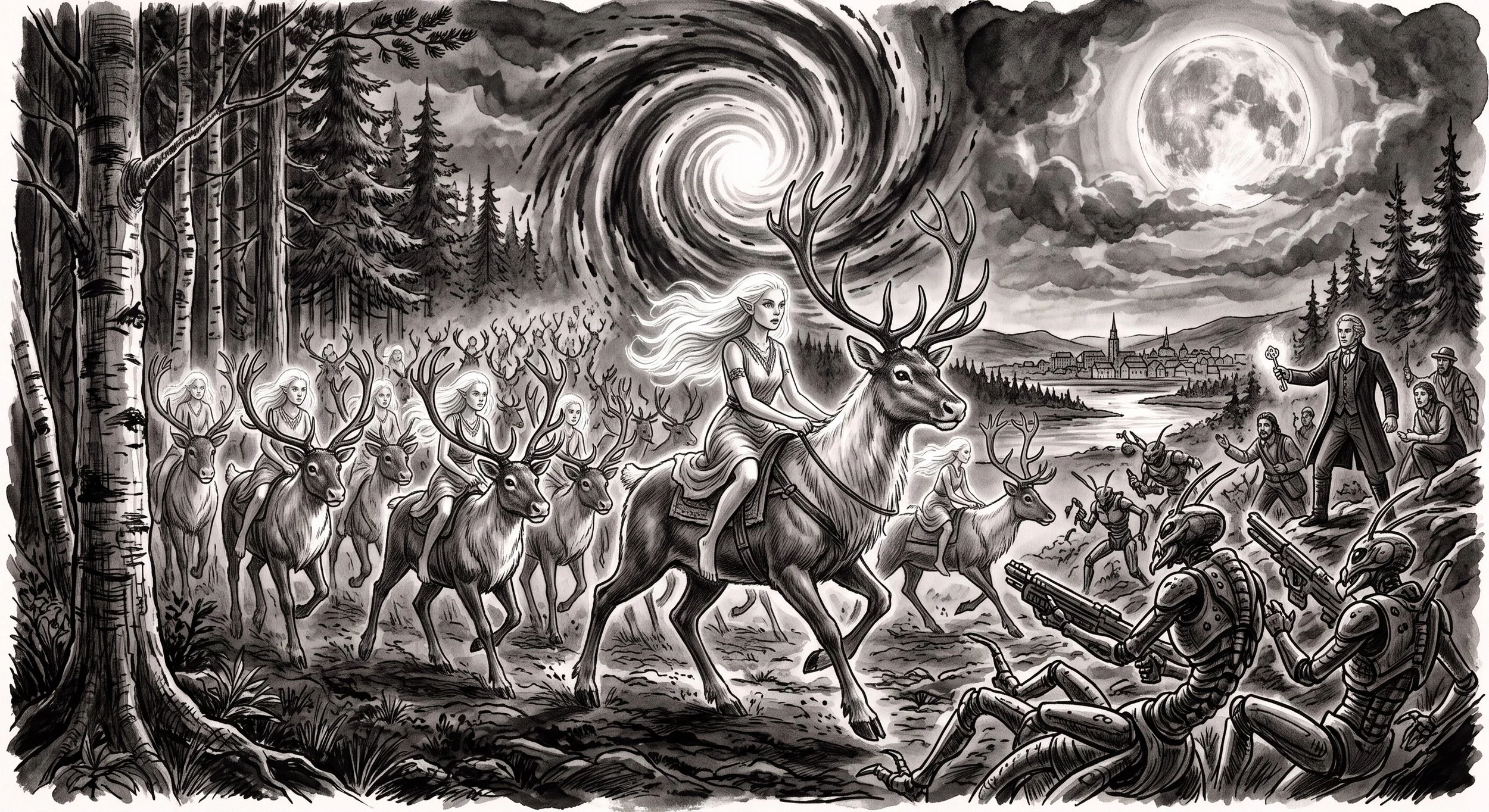
The novel reimagines the Huldra as diminutive, glowing, spirit-like female creatures with long, flowing white hair who ride on the backs of reindeer. They are classified as interdimensional beings who migrated to Earth from another level of reality, rather than traditional earthly spirits. Aligning with their mythological roots, the novel notes that when the Huldra first arrived centuries ago, they engaged in their traditional habit of seducing hunters lurking in the Norwegian woods.
The immortal protagonist, Walker, forced the Huldra to abandon these predatory activities under the threat of banishing them back to their home world, turning them into long-standing allies. During the narrative's climax, Walker summons the Huldra tribe to lead a massive reindeer cavalry charge against the heavily armed alien Set Milian'na, providing a critical distraction that saves Walker's human companions.